


HOA Fees in Greater Baton Rouge (2026): What Buyers Pay, What's Covered, and How Condos Differ from TownhomesBy Kevin Young, REALTOR® | Kevin's Corner | Baton Rouge Real Estate Market
Insurance Relief And St George Permitting Bottlenecks
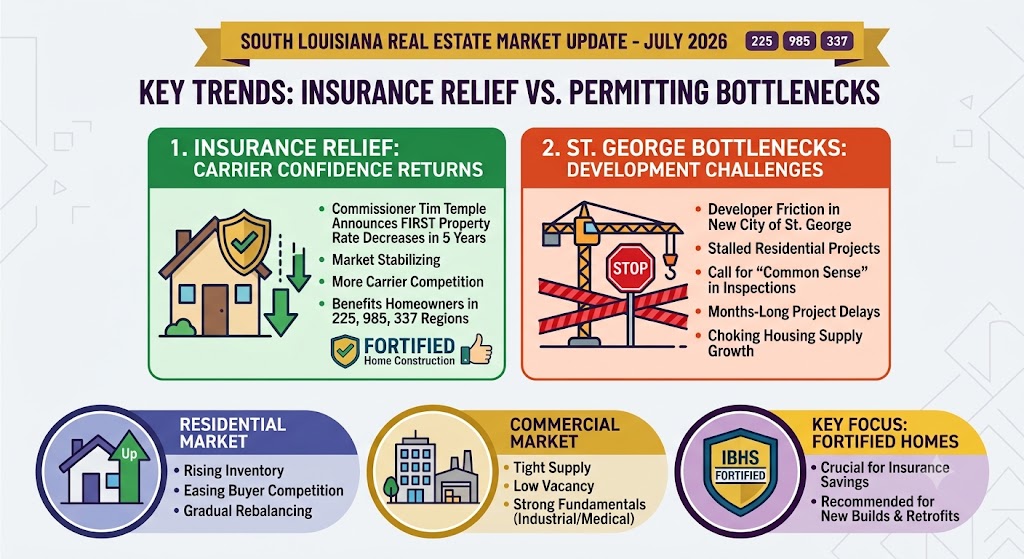
South Louisiana is entering the second half of 2026 with a market defined by two competing storylines. On one hand, homeowners and buyers across the 225, 985, and 337 regions are finally receiving a meaningful signal that the insurance crisis, which has burdened the state for years, may be easing. On the other hand, developers in the newly incorporated city of St. George are running into a permitting wall that is threatening to choke off new residential construction at exactly the moment when more housing supply is most needed. These two forces are not unrelated; they form a portrait of a market in transition, making progress in some corners while stumbling in others. Understanding where the friction is and what relief is actually on the way is essential for every buyer, seller, investor, and homeowner operating in this region right now.
Insurance Commissioner Tim Temple Delivers a First in Five Years
The headline that turned heads across the Louisiana real estate community came from Insurance Commissioner Tim Temple, who announced what no commissioner had been able to deliver in half a decade: actual property insurance rate decreases. This development is not cosmetic. Louisiana homeowners have been dealing with some of the most brutal insurance premium increases in the country, driven by a combination of hurricane exposure, post-Ida claims exhaustion, and a mass exodus of carriers from the state market.
Kevin's Insight: Rate decreases do not happen in a vacuum. They signal that carriers who stayed in Louisiana are recalibrating their risk models and beginning to see the state as a more stable operating environment. For homeowners who have been quietly absorbing cost increases year after year, this is the first tangible evidence that the market dynamics are shifting in their favor.
The movement Commissioner Temple is describing reflects a broader improvement in carrier confidence, which is tied in part to the expansion of fortified home construction standards across the state. When more homes in a region are built or retrofitted to fortified specifications, the overall risk pool becomes less volatile. Insurers respond to that kind of structural improvement. The announcement is also significant because it may bring previously hesitant buyers back to the table; insurance costs have been a quiet deal-killer for months, particularly in the 985 region where coastal and near-coastal properties carry the highest premium exposure.
Regional Watch: Buyers in Livingston Parish, St. Tammany, and the northshore communities of the 985 region should move quickly to lock in quotes from carriers who are now operating in a more competitive environment. Rate decreases tend to cluster in cycles; getting ahead of this one could mean meaningful annual savings on a policy that, just two years ago, felt entirely out of reach.
The St. George Permitting Problem: Growth Outpacing Governance
While the insurance news offers optimism, the situation unfolding in St. George presents a different challenge. Real estate professionals and builders operating in Louisiana's newest city have formally raised concerns about the permitting office, calling for leadership changes and citing what they describe as overly rigid inspections and a lack of practical judgment that is stalling residential projects. The specific phrase used by those within the industry, "common sense," has become something of a rallying cry; it reflects a frustration with enforcement that, according to those on the ground, prioritizes procedural exactness over functional outcomes.
St. George incorporated with an explicit promise to its residents: higher standards, better services, and more accountable governance than what the unincorporated East Baton Rouge Parish model had provided. That promise was and remains legitimate. But there is a difference between higher standards and unintelligible standards. When experienced builders with strong track records across the broader 225 region find themselves stuck in permitting limbo not because their work is substandard but because inspections are being applied inconsistently or without practical context, it creates a real drag on housing supply.
The Developer Perspective: Several builders operating in St. George have indicated that projects are being delayed not weeks but months due to permitting friction. In a housing market that is still working to close an inventory gap, a months-long delay on a residential project is not a paperwork inconvenience; it is a supply chain failure with direct consequences for home prices and buyer access.
The city's leadership now faces a balancing act. Responding to developer concerns does not mean abandoning the higher-standard vision that motivated incorporation. It means ensuring that the permitting office operates with the clarity, consistency, and professionalism that both residents and builders deserve. A permit office that cannot communicate expectations clearly or apply standards uniformly is not upholding higher standards; it is creating confusion that ultimately raises costs for everyone, including the homebuyers St. George was designed to serve.
The Broader Market Shift: Inventory Rising, Competition Easing
Zooming out from the two dominant pain points, the overall picture for South Louisiana residential real estate is one of gradual rebalancing. Rising inventory across the 225, 985, and 337 regions is giving buyers more options and more leverage than they have experienced in years. Sellers, in turn, are adjusting their pricing expectations, a shift that signals a market maturing out of the post-pandemic frenzy and settling into something more sustainable.
This does not mean prices are collapsing. The fundamentals supporting South Louisiana home values remain intact: a strong employment base tied to petrochemical and healthcare industries, continued in-migration from higher-cost metros, and a persistent undersupply of move-in-ready properties in desirable school districts. What it does mean is that buyers no longer need to waive every contingency and offer dramatically over asking price to compete. That is a healthy development for long-term market stability.
Seller Strategy Note: Sellers who priced aggressively in 2024 and early 2025 may find that the same strategy produces slower results in mid-2026. Homes that are priced correctly from day one are still moving well; those that require a price reduction are spending more time on market and ultimately netting less. Professional pricing guidance at the listing stage has never been more important.
Commercial Real Estate: Tight Supply and Strong Fundamentals
On the commercial side of the ledger, the story across the 225, 985, and 337 regions is one of persistent constraint. Limited new construction has kept commercial supply tight even as demand from industrial, medical, and mixed-use tenants remains strong. Vacancy rates in key commercial corridors remain low, and lease rates are reflecting that scarcity. For investors watching this segment, the absence of significant new supply coming online in the near term suggests that existing well-positioned commercial assets will continue to hold and potentially grow their value through the balance of 2026.
The industrial sector in particular continues to benefit from South Louisiana's logistical advantages: access to the Mississippi River corridor, proximity to major port infrastructure, and a workforce trained for the energy and manufacturing sectors. These are structural advantages that do not erode in a single market cycle. Investors with a long-term horizon who are positioned in South Louisiana industrial assets are well placed for continued stability.
5 Years Duration Since Louisiana's Last Property Insurance Rate Decrease, Now Reversed by Commissioner Tim Temple
3 Regions South Louisiana Market Zones Covered: The 225, 985, and 337 Corridors, All Showing Rising Inventory in Mid-2026
Low Commercial Vacancy Rate Across Key 225, 985, and 337 Corridors Driven by Limited New Construction Deliveries
Months Reported Project Delay Duration Cited by St. George Builders Navigating the City's Current Permitting Friction
Fortified Homes: The Insurance and Construction Connection
One thread that ties the insurance relief story to the construction conversation is the growing role of fortified home standards across South Louisiana. The Insurance Institute for Business and Home Safety's Fortified program has gained significant traction in Louisiana as both a builder differentiator and a policy tool. Homes built or retrofitted to fortified standards qualify for meaningful insurance discounts with participating carriers, and as more carriers return to the Louisiana market, those discounts are becoming a competitive recruitment tool.
For developers in St. George and across the region, building to fortified standards is increasingly not just a marketing advantage but a practical financial necessity for their buyers. A buyer who can demonstrate a fortified designation on their home is in a materially better position when shopping insurance carriers than one who cannot. This creates a direct incentive loop: builders who embrace fortified construction attract more qualified buyers; those buyers save on insurance; that savings translates into purchasing power that supports stronger sale prices.
Builder and Buyer Alignment: If you are currently working with a builder on a new construction project anywhere in the 225 or 985 region, ask directly whether the home is being built to Fortified Silver or Gold specifications. The upfront cost differential is increasingly modest; the long-term insurance savings can be substantial. This is especially true in the 985 corridor where storm exposure premiums have historically been the highest.
What This Means for Buyers and Sellers Right Now
For buyers, July 2026 represents one of the better entry windows in recent memory. Insurance costs are beginning to moderate; inventory is rising; sellers are more negotiable than they were 18 months ago. Buyers who have been sitting on the sidelines waiting for conditions to improve should take note: the conditions are improving, but they will not remain in this configuration indefinitely. As insurance relief takes hold and market confidence rises, buyer competition will intensify again.
For sellers, the message is one of precision. The market is not punishing well-priced, well-presented homes; it is punishing overpriced ones. Sellers who invest in preparation, price correctly from the start, and work with an agent who understands local absorption rates are still achieving strong outcomes. The days of listing high and waiting for a bidding war are fading; the days of strategic positioning are here.
Kevin's Bottom Line: Two forces are running in opposite directions right now. Insurance relief is opening the market; permitting friction in St. George is constricting one piece of it. Buyers, sellers, and investors who understand both dynamics are better equipped to make decisions that hold up not just today but over the next three to five years. That is what this report is designed to deliver.
Curious how this impacts your property value?
Let's Find Out!Frequently Asked Questions
FAQ
What does the Louisiana insurance rate decrease actually mean for homeowners in the 225 and 985 regions?
Commissioner Tim Temple's announcement marks the first property insurance rate decreases Louisiana homeowners have seen in five years. For homeowners in the 225 and 985 regions, this means that carriers operating in the state are beginning to stabilize their pricing models after years of post-hurricane losses and market exits. In practical terms, you should contact your current carrier and ask whether your specific policy is subject to a rate adjustment at renewal. You should also shop competing carriers, as the returning competitive environment means you may find better pricing than you have been locked into. Homeowners with fortified designations are positioned to benefit most, as participating carriers offer additional discounts on top of any rate adjustments. This development also has implications for buyers who were priced out by insurance cost projections; it is worth revisiting those calculations with updated quotes.
FAQ
How serious is the St. George permitting bottleneck, and will it affect home prices in that area?
The St. George permitting friction is a real and documented concern, not merely an industry complaint. Builders and real estate professionals operating in the city have formally called for leadership changes in the permit office, citing months-long delays caused by inconsistent and overly rigid inspection practices. When new construction stalls for months, the pipeline of available homes for buyers shrinks, which tends to support or increase prices on existing inventory in the short term. However, prolonged bottlenecks also deter builder investment, which can suppress long-term growth potential for the area. If St. George's leadership responds constructively and brings greater clarity and consistency to the permitting process, the city's strong foundational demand should translate into healthy, stable price appreciation over time. If the friction persists, buyers and builders may redirect investment toward other parts of the Greater Baton Rouge market where the development process is more predictable.
FAQ
What is a "Fortified" home, and how does it impact my insurance premium?
A "Fortified" home is built or retrofitted to structural standards set by the Insurance Institute for Business & Home Safety (IBHS) to withstand severe weather like hurricanes and high winds. In Louisiana, homes with an official Fortified designation qualify for meaningful, state-mandated property insurance discounts. Investing in these resilient construction practices not only dramatically reduces your ongoing coverage costs, but also protects your equity and makes your property highly competitive when shopping for returning insurance carriers.
 The multiple listing information is provided by the Greater Baton Rouge Association of REALTORS®, Inc. multiple listing service from a copyrighted compilation of listings. The compilation of listings and each individual listing are ©2026 MLS. All Rights Reserved. The information provided is for clients' personal, non-commercial use and may not be used for any purpose other than to identify prospective properties clients may be interested in purchasing. All properties are subject to prior sale
